
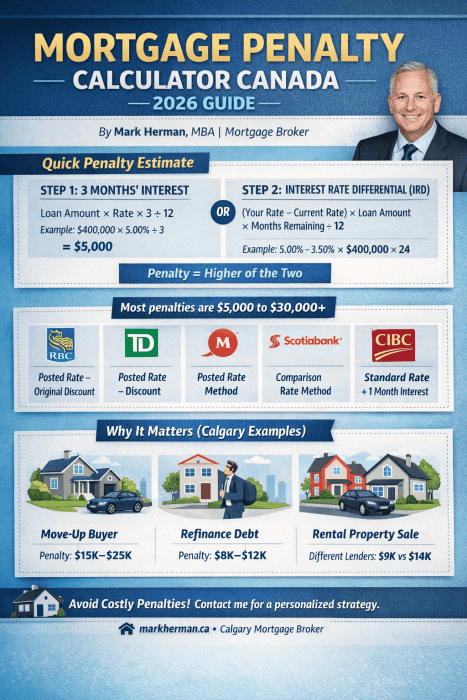
Mortgage Penalty Calculator Canada: How Fixed-Rate Penalties Are Calculated (2026 Guide)
Written by Mark Herman; MBA in Finance – Mortgage Broker with 22 Years of Experience
Quick Answer: Mortgage Penalty in Canada
If you break a fixed-rate mortgage in Canada, your penalty is usually:
- 3 months’ interest, or
- Interest Rate Differential (IRD)
You pay whichever is higher.
Most fixed-rate penalties in 2026 fall between:
- $5,000 to $30,000+
The exact amount depends heavily on how your lender calculates IRD.
Mortgage Penalty Calculator (Quick Estimate)
Use this simple method to estimate your penalty:
Step 1: 3 Months’ Interest
Formula:
Mortgage balance × interest rate × 3 ÷ 12
Example:
- $400,000 mortgage
- 5.00% rate
Penalty ≈ $5,000
Step 2: Estimate IRD – Interest Rate Differential
Formula:
(Your rate − current comparable rate) × balance × remaining months ÷ 12
Example:
- Balance: $400,000
- Your rate: 5.00%
- Current rate: 3.50%
- 24 months remaining
IRD ≈ $12,000
Your real penalty = the higher of the two
What Is a Mortgage Penalty?
A mortgage penalty is a fee you pay if you break your mortgage early by:
- selling your home
- refinancing
- switching lenders
- paying off your mortgage before the term ends
Fixed-rate mortgages almost always have higher penalties than variable-rate mortgages.
Why Fixed Mortgage Penalties Are So High
1. IRD replaces simple interest
Variable mortgages:
- 3 months’ interest is the max payout penalty
Fixed mortgages:
- The GREATER of 3-months interest or the IRD calculation (which ever is higher)
2. Rate changes increase penalties
If rates drop after you lock in:
- Your rate = higher
- Current rate = lower
Bigger gap = bigger penalty.
The bank says they were making all that interest before and now that you pay them back they will lend the money out at a lower rate so they need to “re-capture the interest that they expected to get before.”
During Covid when Calgary home owners mortgage rates were about 4% and the rates dropped to 2%, the IRD payout penalties were in the range of $20,000 to $45,000 on 5-year fixed mortgages!! What?
3. Each bank uses a different formula
This is the most important point.
Two identical mortgages can have very different penalties depending on the lender.
How Banks Calculate Mortgage Penalties (Canada)
RBC
- Uses IRD based on:
- posted rate for similar term
- minus your original discount
More complex than a simple “current rate” comparison
TD
- Uses posted rate for similar term
- subtracts your original discount
Often results in higher penalties than expected
BMO
- Similar to TD and RBC
- Uses posted rates and discount adjustments
Scotiabank
- Uses posted rate for closest remaining term
- adjusted for your original discount
- includes present-value calculation
CIBC
- Uses a comparison mortgage method
- compares:
- your rate (plus discount)
- vs current posted rate
Can produce significantly higher penalties
National Bank
- Uses a standard rate / posted rate approach
- adds capped 1 month interest component
Different structure than other banks
Why This Matters (Real Calgary Examples)
Example 1: Move-Up Buyer in Calgary
- Bought in 2023
- Needs bigger home in 2026
- Mortgage: $520,000
- Fixed rate: 4.79%
- 3 years remaining
Penalty could be $15,000–$25,000
Example 2: Refinancing to Pay Off Debt
- Calgary condo owner
- Wants to consolidate debt
- Mortgage: $300,000
- Fixed rate: 5.19%
Penalty: $8,000–$12,000
Still worth it in some cases—but must be calculated properly
Example 3: Rental Property Sale
- Investor selling in Calgary
Difference between lenders:
- Bank A: $9,000 penalty
- Bank B: $14,000 penalty
Same borrower, different lender = big difference
Fixed vs Variable Mortgage Penalties
| Mortgage Type | Typical Penalty |
|---|---|
| Variable | 3 months interest |
| Fixed | IRD or 3 months (whichever is higher) |
Fixed penalties are often 2–5x higher
How to Reduce or Avoid a Mortgage Penalty
1. Use prepayment privileges
Most lenders allow:
- 15% lump sum annually
- 15% payment increases, and doubling the payment
2. Consider portability
You may be able to transfer your mortgage to a new property and not pay the penalty as you are not closing down your mortgage. You are porting it to another address.
3. Time your refinance
Waiting until renewal = no penalty
4. Choose the right lender upfront
This is the biggest factor.
Rate matters—but penalty structure matters more long-term
Internal Resources (Recommended Reading)
- Minimum Down Payment Canada: Rules, Examples & Options
- How Much Income Do You Need to Buy a House in Calgary
- Fixed vs Variable Mortgage Rates in Canada
- OnlyFans Mortgage in Canada
- Mortgage Renewals Guide
FAQ: Mortgage Penalties in Canada
How is a mortgage penalty calculated?
It is the greater of:
- 3 months’ interest
- IRD (interest rate differential)
Why are fixed mortgage penalties so high?
Because IRD estimates the lender’s lost interest over time—not just a simple fee.
Can two banks charge different penalties?
Yes—and the difference can be thousands of dollars.
Can I avoid a mortgage penalty?
Sometimes, by:
- porting your mortgage
- waiting until renewal
- restructuring your mortgage
Is there a standard penalty formula in Canada?
No. Each lender uses its own variation of IRD.
Bottom Line
Most borrowers focus on:
getting the lowest rate
But ignore:
how expensive it is to break the mortgage
In many cases:
The penalty matters more than the rate. Depending on your situation – like moving out of the country in 1 or 2 years.
If you’re planning to:
- refinance
- sell early
- restructure your mortgage
I can help you:
- estimate your real penalty
- compare lender formulas
- avoid costly mistakes
Reach out for a personalized strategy.